
Echols County Criminal Court Files
In Georgia, Superior Court is the broad trial court for felony criminal cases. Echols County belongs to the Southern Judicial Circuit, which also includes Brooks, Colquitt, Lowndes, and Thomas Counties. The Clerk of Superior Court in Statenville is the starting point for felony criminal case files, while Probate/Magistrate Court handles certain lower-court functions, traffic matters, pre-warrant applications, and first-step proceedings depending on the issue.
A criminal court file begins after formal action reaches the court. It may include an indictment, accusation, or other charging document, then arraignment entries, motions, hearing notices, orders, plea entries, trial information, disposition, sentence, probation terms, bond entries, and calendar events. For the arrest and charge pathway before the case outcome, use the Echols County arrest records and court charges page. For custody status after an arrest, jail information is separate because Echols arrestees are housed at Lowndes County Jail.
Note: A criminal court record can show a charge that was later reduced, dismissed, or nolle prossed.
Search Echols County Criminal Records
The county research did not locate a complete Echols-only public criminal case-search database. The practical search path is to use the Clerk of Superior Court for felony case files and use Georgia Courts e-access or re:SearchGA only after checking provider participation. The Clerk of Superior Court is listed at 110 Hwy 94 East, Statenville, GA 31648, with phone 229-559-5642 and fax 229-559-5792. Mail may be sent to P.O. Box 213, Statenville, GA 31648.
- Identify the court: Superior Court for felony case files, Probate/Magistrate Court for traffic or lower-court matters.
- Gather the defendant name, case number, filing year, charge, or court date if known.
- Call or visit the Clerk of Superior Court for the court file or certified-copy request.
- Check Georgia Courts e-access or re:SearchGA as an account-based option, but verify Echols participation.
- Use the Southern Judicial Circuit calendar-call PDF for a public docket snapshot, not for full pleadings.
The Prosecuting Attorneys' Council page for Echols County is an assigned source for the local criminal prosecution contact.
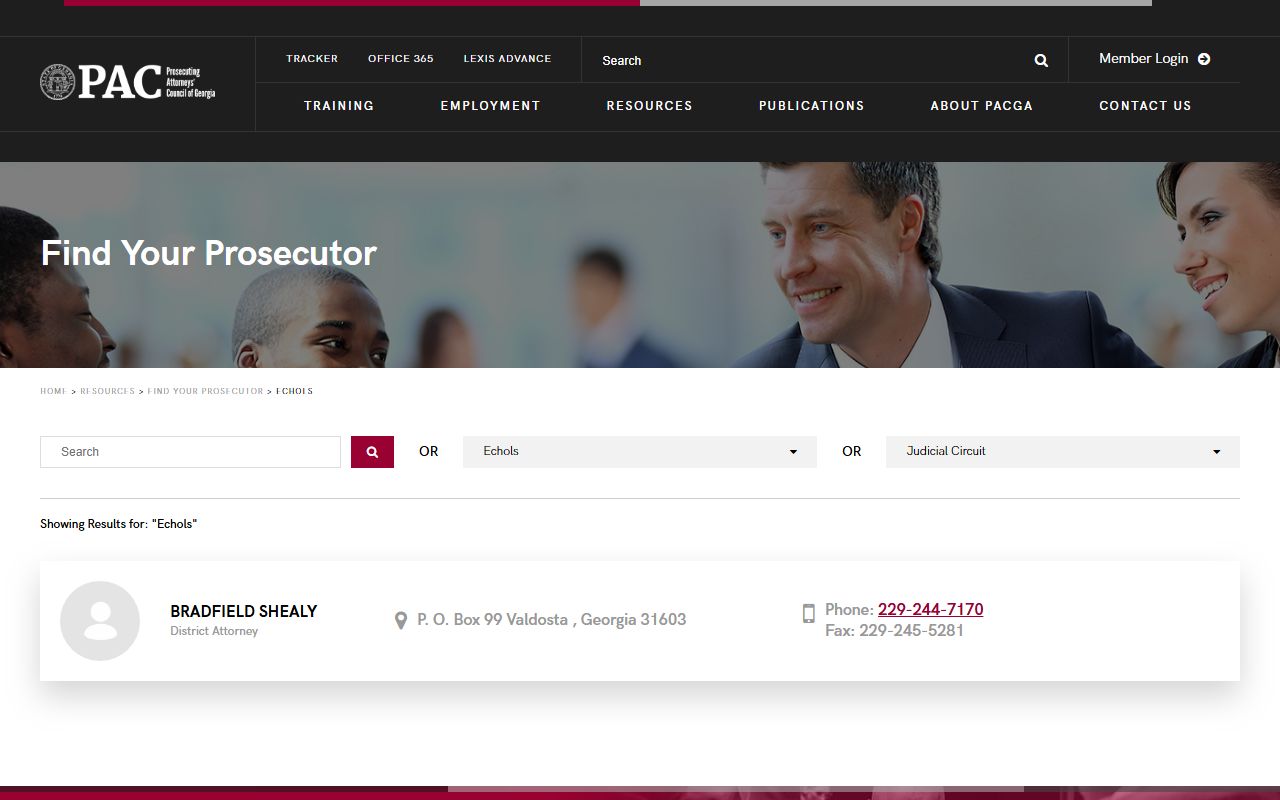
The prosecutor source helps identify the office that pursues state criminal charges, while court records themselves remain with the court clerk.
Echols County Criminal Case Stages
A criminal court record should be read as a sequence. The earliest law-enforcement event may be an arrest, citation, or warrant. The court case then develops through charging, arraignment, pretrial filings, plea negotiations or trial, disposition, and sentencing. Each stage can add entries to the court record. A calendar-call listing can show the case number, date, status, cause, and attorneys, while the full file may contain the orders and pleadings behind those entries.
Case flow: Charges Filed › Arraignment › Pretrial / Motions › Plea or Trial › Disposition › Sentencing
Charges filed: the court record may receive the formal charge document, case number, defendant name, offense, and court assignment when public. Arraignment: the record shows that the charge was presented and that a plea was entered or scheduled. Pretrial and motions: entries can include motions, orders, continuances, bond issues, discovery disputes, or calendar events.
Plea or trial: the record may show a plea form, verdict, trial calendar entry, or order resolving issues before judgment. Disposition: each charge receives an outcome, such as guilty plea, dismissal, acquittal, or nolle prosequi. Sentencing: the file may show custody, probation, fines, costs, restitution, or other court-ordered terms.
Echols County Criminal Record Fields
Criminal court records in Echols County may contain the same fields shown across the broader court-record research: case number, filing date, court, county, case status, style, cause, attorneys, docket entries, financial fields, hearing fields, and documents. In a criminal file, the most important parts are the defendant name, charging document, plea, disposition, sentence, and any order changing the charge or restricting the record. The court file may not show jail commissary, visitation, or current custody status.
| Field | What It Shows |
|---|---|
| Case number | The court's tracking number for the criminal matter. |
| Defendant | The person accused in the criminal case. |
| Charges | The offense or offenses filed by indictment, accusation, or other charging document. |
| Arraignment / plea | The defendant's formal response, such as guilty, not guilty, or another plea entry. |
| Motions and orders | Written requests and judge rulings during the case. |
| Disposition | The outcome for each charge, which may differ from the original arrest allegation. |
| Sentence | Custody, probation, fine, cost, restitution, or other court-ordered consequence. |
Echols County Criminal Case Offices
The District Attorney prosecutes state criminal cases in the Southern Judicial Circuit, including Echols County. The Prosecuting Attorneys' Council of Georgia lists Bradfield Shealy as District Attorney for Echols County, with P.O. Box 99, Valdosta, GA 31603, phone 229-244-7170, and fax 229-245-5281. The DA's office is not the court clerk, but it is central to how charges are pursued, reduced, dismissed, or presented to court.
The public defender source is also important for criminal cases. The Georgia Public Defender Council Echols County map entry identifies the Southern Circuit public defender contact.
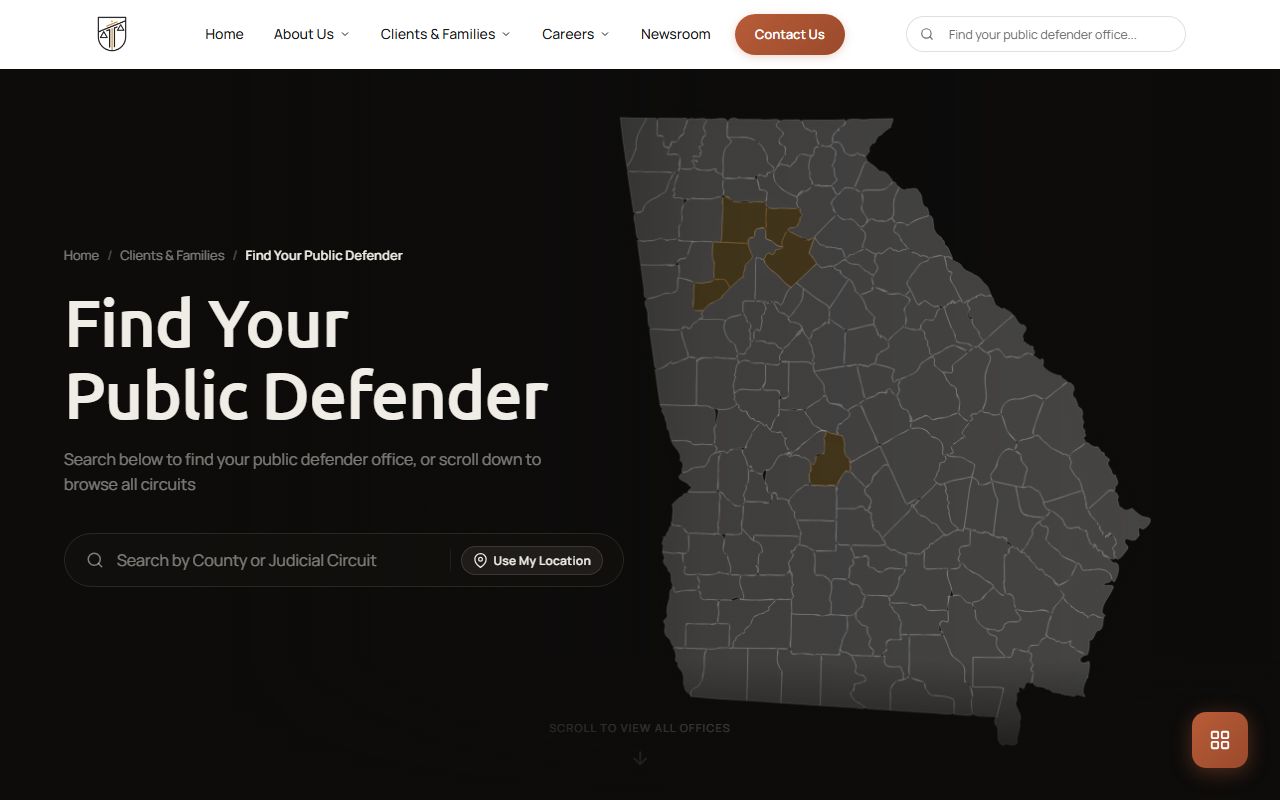
Public defender contact details help people locate counsel resources, but eligibility and appointment decisions depend on the court process.
The Southern Circuit public defender local office page is the third assigned criminal-court image source.

The GPDC pages list a Valdosta office and phone details, but the research notes an address discrepancy between GPDC pages, so calling before travel is the safest path.
Echols County Charges vs Convictions
A charge is an accusation or formal count filed in court. A conviction is an outcome after a guilty plea, guilty verdict, or other conviction-producing result. One arrest can produce several charges. Some charges can be amended, reduced, dismissed, no-billed, or nolle prossed. That is why criminal court records must be read charge by charge instead of assuming the first listed offense became the final result.
| Charge | Conviction | |
|---|---|---|
| Record stage | Appears when an offense is filed or listed in the case. | Appears after plea, verdict, or other qualifying disposition. |
| Meaning | An allegation or count to be resolved. | A final outcome that the defendant was found or pleaded guilty. |
| Can change | May be amended, reduced, dismissed, or nolle prossed. | Can be modified only through court action, appeal, or later relief. |
| Best source | Charging document and docket entries. | Disposition and sentencing records. |
Read Echols County Criminal Dispositions
Disposition means the final outcome of a charge or case. The research glossary identifies disposition as the final outcome, plea as the defendant's formal response, sentence as the punishment ordered after conviction or plea, and probation as a court-supervised sentence served outside jail or prison. A criminal record may show several dispositions in the same case when multiple charges are filed. It may also show a sentence that includes jail, prison, probation, fines, court costs, restitution, or treatment conditions.
- Arraignment
- Hearing where charges are read and a plea is entered or scheduled.
- Nolle prosequi
- A prosecutor's decision not to pursue a charge, often shortened to nolle pros or nolle prossed.
- Disposition
- The final result for a charge, such as guilty, dismissed, acquitted, or nolle prossed.
- Sentence
- The punishment or conditions ordered after a conviction or guilty plea.
Restricted Echols Criminal Records
Georgia commonly uses the term record restriction where many people say expungement. The research cites O.C.G.A. 35-3-37 for Georgia criminal record restriction and explains that restriction can limit public criminal-history dissemination for eligible arrests or charges. It does not automatically erase every court file. A sealed court record is different because it is closed from ordinary public inspection by law or court order.
| Sealed Record | Record Restriction / Expungement Term | |
|---|---|---|
| Public visibility | Closed from ordinary public inspection by law or court order. | Limits eligible criminal-history dissemination under Georgia rules. |
| Typical trigger | Juvenile, adoption, protected information, court order, or statutory confidentiality. | Eligible dismissal, nolle prosequi, no-bill, or other qualifying outcome. |
| Does it delete every court file? | No, access is controlled. | No, restriction is not the same as deleting all court documents. |
| Who confirms access? | The court that controls the file. | The court, prosecutor, GBI, or agency process tied to the record. |
Echols Criminal Record Access
Public access to criminal court records sits beside several limits. O.C.G.A. 50-18-70 supports the general public-record presumption, O.C.G.A. 50-18-71 addresses inspection, copies, and lawful fees, and O.C.G.A. 50-18-72 addresses exemptions. Juvenile records, sealed files, protected personal data, medical information, Social Security numbers, and some investigative records can be withheld or redacted. Law-enforcement reports should be requested from the sheriff, not from the clerk, when the record is an arrest, incident, or crash report rather than a filed court case.
For sheriff records tied to a criminal matter, the Echols County Sheriff's Office open-records form requires requestor details and incident details, cites the three-business-day research expectation, and lists copy and labor rules. For court records, use the Clerk of Superior Court or the court that created the file. For state custody after sentencing, Georgia DOC search channels are separate from the county criminal court record.